
Can a change in language move us away from conflict and closer to peace?
Camila Reyes Azcuénaga has traveled to areas of the country impacted by violence to sow a new form of connection in the communities.
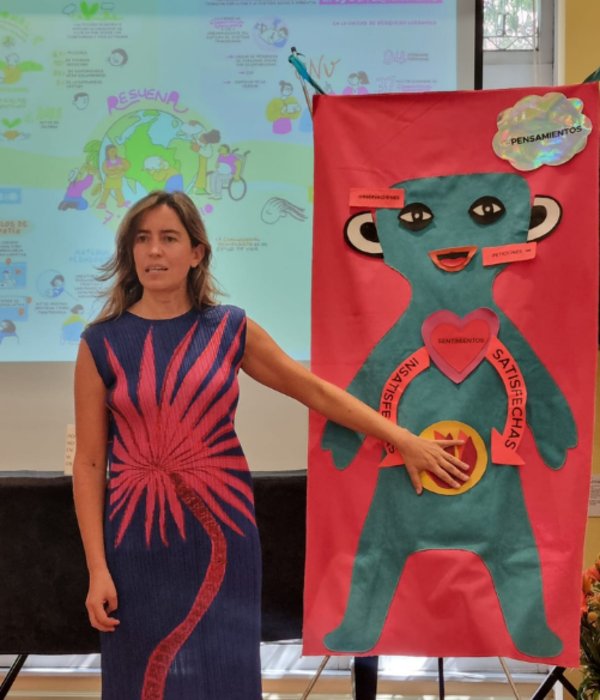
It all started with a phrase she overheard at a work meeting. Camila Reyes Azcuénaga was part of the presidential program against antipersonnel mines and was in Putumayo, meeting with the Awá indigenous community. During the conversation, one of the attendees read a list of more than one hundred victims : people who had disappeared, others who had been maimed by mines, and orphaned children. As soon as they finished reciting their names, one of the government officials said:
—Let's move on to the next item on the agenda.
Those words resonated deeply with Reyes. For her, it was impossible to think of each of those one hundred people as "just another item on the agenda." After two years working on that team, she decided to resign. "I didn't want to dehumanize myself," she says.
The conflict in the country had never been a matter of indifference to her. Even before receiving her degrees in law and political science, she was already interested in working closely with the victims. “I grew up in Bogotá, in a privileged home. I had seen the war through television screens, from car windows, but I didn’t want to stop there, ” Reyes adds. “I needed to know where people were, how they were living.”
That's how she came to be part of the landmine clearance program. However, she didn't find what she was looking for there. "I realized that I wasn't interested in working to mitigate the impacts of war, but to prevent it from happening." And she asked herself a question: how to contribute to building peace from the ground up.
She traveled to New York in 2011, full of ideas, and there she found what would become the definitive path in her search. At that time, the Occupy Wall Street movement was beginning. Protest voices were being heard in many parts of the world, and groups of the indignant were emerging. On a table set up in a park, Reyes saw a sign that read: 'Nonviolent Communication'. "That's where this journey began," she recalls.
She approached and asked. It was an invitation to participate in the training sessions of the educational program created by the American psychologist Marshall Rosenberg in the early 1960s, which, broadly speaking, proposes strengthening human relationships through communication that prioritizes empathy, connection, and nurturing bonds.
In his book Nonviolent Communication: A Language of Life (1999), Rosenberg wrote: “While studying the factors that affect our capacity for compassion, I was struck by the primary role played by both language itself and our use of words. I have since identified a specific approach to communication—speaking and listening—that leads us to give from the heart, to connect with ourselves and others in a way that allows our natural compassion to emerge. I call this approach nonviolent communication .”
Rosenberg created a series of methods applicable to everyday life and all relational contexts—family, partners, work, community. Camila Reyes encountered this world when she saw the advertisement in New York. She attended the training sessions and completed the program developed by the American psychologist. Today, she is one of the few people officially certified by The Center for Nonviolent Communication (CNVC). There are only twenty in Latin America. “In nonviolent communication, I found something that Colombia desperately needed, and still needs: the language of compassion.”
—What key point stands out in this communication model?
“When I worked with indigenous communities and displaced people, it became clear to me that what hurt them most was the way they were treated. The dehumanization,” Reyes replies. “ Thanks to nonviolent communication, I understood that, before laws and policies, we need to learn something more basic: to treat each other as human beings. To feel, to listen, to observe, to understand the needs of the other. This communication invites you to recognize your own humanity and that of others without the need for mediation. It is a knowledge that can generate a very high transformative impact, but it remains marginal.”
That's why Camila Reyes has focused her work on sharing what she's learned and training communities in the fundamental methods of this communication. As soon as she returned to Colombia, she rejoined various peace-related programs. For several years, she collaborated with the Search Unit for Missing Persons. "That was the experience where I really started to gain strength," she says. Then she began direct action in regions of the country heavily impacted by the armed conflict, such as Montes de María, Bajo Cauca, northern Cauca, and Buenaventura, areas where she has dedicated herself to building a network of "planters of nonviolent communication."
“The idea is that each of us takes responsibility for our own little bit, that we strive for the peace that depends on ourselves.”
Camila Reyes AzcuénagaNonviolent Communication
For Reyes —who seven years ago created the Resuena Foundation precisely with the objective of spreading this knowledge in Colombia and throughout Latin America— “it has been beautiful to see how a way of connecting with life is beginning to gain strength, leading us to move from relationships and systems based on domination to relationships and systems based on communication.”
—Based on what you find in your work, what is the biggest obstacle to non-violent communication?
—“Judgments. The interpretive framework through which we read ourselves. We learned to filter the world through our own beliefs. What fits with your belief is right, and what doesn't is wrong. But the moment you say 'right' or 'wrong,' you immediately transform into a judge. When that happens, you separate yourself, because you place yourself above others. And by separating yourself, you suffer. You no longer see the needs of others, but rather the hostile image you created of him or her through judgment.”
—What does the nonviolent communication method propose in this case?
—“It shows you how you can maintain a connection with yourself and with others. If you are connected to yourself, it is more difficult for someone else to think or decide for you, and it is also more difficult for you to decide or think for someone else, because there is respect and recognition. It is an awareness of interdependence. We are used to satisfying our needs at the expense of others, or the needs of others at the expense of ours. Nonviolent communication teaches us to interrupt that pattern of separation and invites us to share power. To take care of myself, of you, of everyone.”
Camila Reyes's proposal is based on Rosenberg's work. The psychologist developed a series of steps to "restructure how we express ourselves and listen to others," without being bound by the kind of automatic reactions that often lead to conflict. Nonviolent communication offers tools for learning to observe without judgment, to identify and express feelings clearly and concretely, to take responsibility for those feelings, and to recognize the needs behind them. And something equally crucial: attending to the feelings and needs of others through empathy.
This is how they have put it into practice in the regions
Milena* lives in a rural district of the municipality of Tarazá, in the Bajo Cauca region of Antioquia, one of the areas most affected by the conflict. A victim of forced displacement, she has become a social leader and presides over the community council of her district. She has been trained in nonviolent communication by Camila Reyes and has noticed the changes that having these tools has brought her:
“I have managed to erase many of the beliefs I grew up with, such as that the one who speaks loudest is the one who is listened to the most, or that the one who strikes first strikes twice. Beliefs that I myself replicated,” says Milena*, who highlights how her relationships improved, not only in the personal sphere, but also in what has to do with her work as a social leader.
“In this area, it’s common that when a conflict arises, if you can’t resolve it with violence, then you turn to armed groups. That’s our daily reality. Even with a police presence, everything ends up in the hands of these illegal groups,” Milena* adds. “But that’s starting to change. Thanks to what we’ve learned about nonviolent communication, when disagreements arise, they no longer call on them, but instead seek us out as leaders. In this way, we’re taking power away from these structures. Of the ten problems they used to resolve, today we solve more than half. That’s a huge step forward.”
Experiences like these are replicated in other regions of the country. “Even a little literacy in this sense helps people a lot to understand what they feel, what they need, and to communicate it without imposing it, ” says Camila Reyes. “Situations that could end in machete attacks, for example, are resolved in a different way because relationships have been humanized.”
—You take this knowledge to areas that are heavily affected by violence. How is it received?
—“There is an immense resonance. It’s as if a light has been turned on in the midst of great darkness. People arrive at a space where someone tells them that there is something other than violence. Because this is not at all clear: many people only know that reality . Through this communication, they begin to discover that building a connection with another person holds much more power. This is key to surviving in a war context. Because there, it can make all the difference. If you react negatively to a group commander, they can kill you.”
Camila Reyes hopes the country will abandon the idea of peace that will only come from a select few sitting down at a negotiating table. For her, there is untapped potential: “There are millions of us who could be building peace in our homes, on the streets, in community action groups, if we had the tools.” Nonviolent communication, Reyes explains, offers a method for integrating this language of peace. And it's not just a language; it's a way of approaching life. “It tells us: first connection, then solution. That's what we need. But if you look at the National Development Plan, you'll see there are no strategies for building peace in everyday life.”
—How do you analyze our political context, from the perspective of the highest leaders, in that sense?
—“Communication levels are very low. They're pointing fingers at each other, defending their own perspectives, their beliefs, their reasons. Each one tries to protect themselves from the other, or they only speak to those in their own groups. I wonder what it would be like if we shifted our focus and stopped dwelling on our own beliefs to seek connection. When you say 'only my way,' violence begins. What if we looked for a strategy that includes more needs? The treasure is walking together, and we're missing out on that. But I refuse to believe that violence is an inevitable fate. Of course, we must abandon the illusion that peace is someone else's job, that it will be done by the ELN or the government. How could it be easier to make peace in the country than in my own home! It isn't. So let's start with what's closest to us; we have plenty of work to do there.”
—What steps do you recommend taking to begin putting this model of nonviolent communication into practice in daily life?
—“Learning to recognize what we feel and need. Focusing on what unites us. Differentiating between observation and interpretation—that is, not believing that what we are interpreting is what is actually happening, that what we think is absolute truth. Taking responsibility for what we feel and not blaming the other person for it. At the foundation, we offer a challenge I wrote to practice nonviolent communication 365 days a year. It's free. We send a daily message for people to practice. In it, we give examples of how we can change, how we can learn to include others. Because the idea is for each of us to take responsibility for our own part, for us to strive for the peace that depends on ourselves.”
Information about the challenge can be found at resuenacolombia.com.
María Paulina Ortiz
Reporter for EL TIEMPO